


Most of the manufacturers face similar problems such as tight delivery schedules, complex processes, lack of information to make informed responses, and low profit. This is the dilemma and challenge faced by most small and medium industries. Thus, a comprehensive ERP (Enterprise Resource Planning) system engineering solution, such as Panna XERM.mfg, or MRP (Manufacturing Resources Planning) system, is a must to help in decision-making, production control, customer fulfillment, and cash flow monitoring, in order to survive in this highly competitive market.
Optimization of resources, streamlining processes, innovative cost control, competitive pricing, quality products, and services are key factors to maintain the company’s competitive advantage and fuel business growth. For distribution businesses, leveraging an ERP system is crucial to enhance operational efficiency and manage resources effectively.
Panna XERM.mfg is a web-based ERP system that integrates an organization’s business processes, such as sales fulfillment, procurement, inventory control, production, and financial accounting. This allows for better data maintenance and operation linkages, moving from standalone to inter-related business entities. With a centralized database, every individual within the organization can extract real-time inquiries and accurate information to assist in completing their tasks and responsibilities.
By using Panna XERM.mfg, you can systematize and standardize your production operations, optimize resource utilization, meet sales delivery schedules, and ensure product quality—making it an essential ERP solution for distributors in Malaysia looking to stay competitive in the market.
Panna XERM.mfg includes modules as:
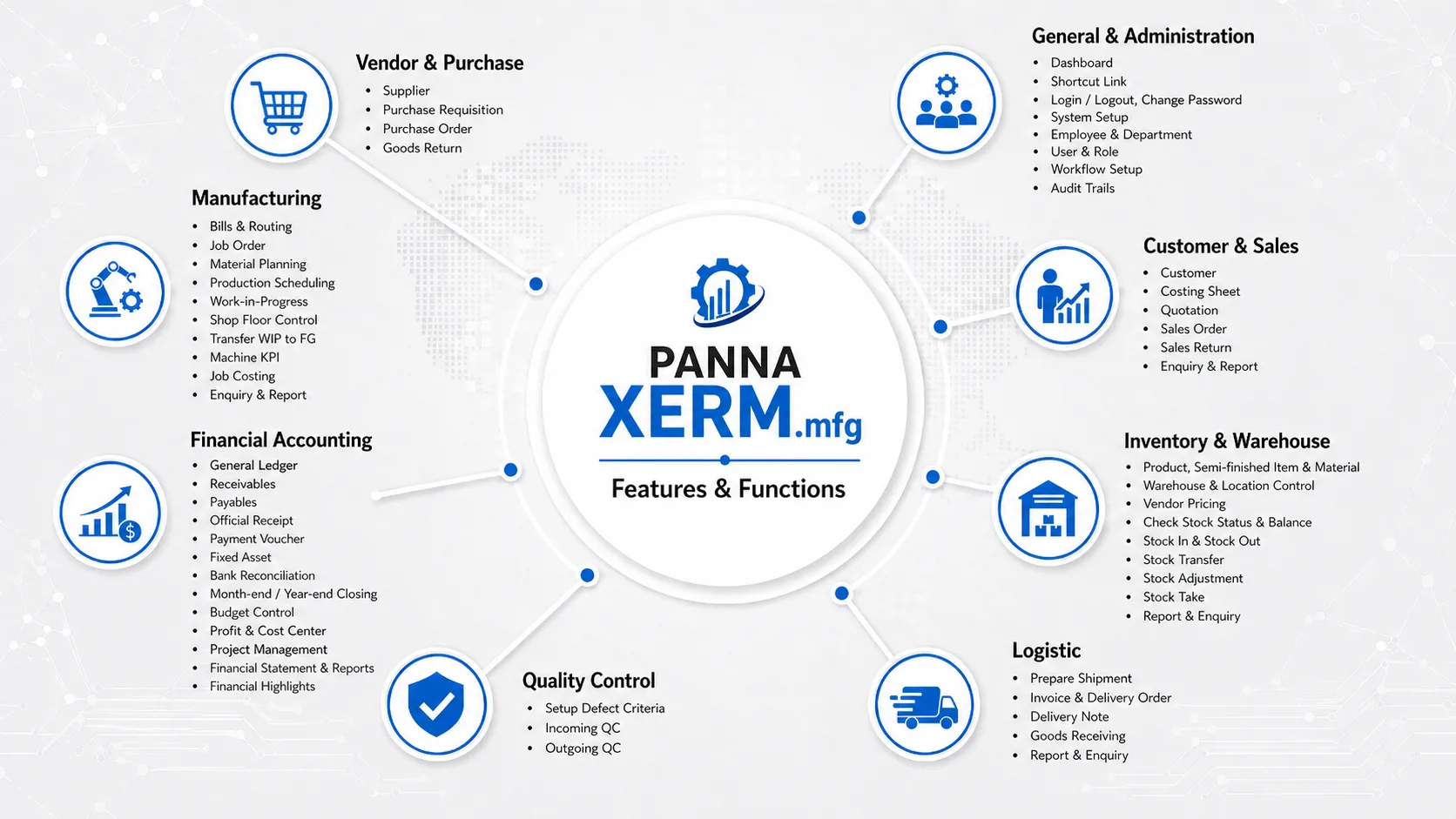
Benefits & Screenshots

Bills & Routing
All your secret recipies are proper kept and inheritance in unlimited bills level

Job Order
Unlimited sub-job orders to cater for multi-levels of product assembly

Smart Material Planning & Sourcing
Help to plan your material purchase moderately and achieve JIT inventory

Product Scheduling
Monitor production status in real time to assist in better production & capacity planning

Bar-code Enablement for Shop Floor Update
Ease the production output update by using barcode and touch-screen panel

Job Cost Analysis
Easily to compare estimated and actual production costing within your finger tip

Measureable Performance
Reduce wastage and machine downtime can save your organization a lot of money
Frequently Asked Questions (FAQs)
1. What is a manufacturing ERP system?
Within the manufacturing module, companies can manage product structures (BOM), production planning, material requirements, shop floor operations, and work-in-progress (WIP). This allows manufacturers to coordinate production activities more effectively, maintain better visibility into operations, and control production costs more accurately.
2. How does ERP automation improve manufacturing efficiency?
By automating routine processes and reducing manual data entry, manufacturers can monitor production activities in real time. With better visibility into material usage, job progress, and production costs, teams can respond faster to production changes and maintain consistent operational performance.
3. What is the role of ERP in engineering and manufacturing operations?
By linking these processes with purchasing and inventory control, businesses can coordinate workflows more effectively, maintain better control over production timelines, and gain clearer visibility into production costing and resource utilization.
4. How can ERP software help manufacturers control production costs?
This allows companies to compare estimated costs with actual production expenses, helping management identify inefficiencies, reduce waste, and improve product costing accuracy for future production runs.
5. Can ERP systems support real-time shop floor monitoring?
With tools such as barcode scanning or shop floor terminals, operators can update production status instantly. This helps supervisors detect delays earlier, manage production resources more effectively, and respond quickly to customer inquiries while committing more reliable delivery dates.
6. Can ERP integrate with IoT or production devices to automate shop floor updates?
This enables manufacturers to update job progress, machine operating hours, production output, and work-in-progress (WIP) without manual data entry. With more accurate and timely production information, managers can monitor shop floor performance more easily, respond faster to production issues, and provide more reliable delivery commitments to customers.
7. How can ERP help manufacturers monitor production KPIs?
By capturing production activities at the shop floor, ERP helps manufacturers evaluate metrics such as machine utilization, machine running time vs net operating time, overall equipment effectiveness (OEE), production wastage, and downtime etc.
8. Does Panna XERM.mfg support Malaysia E-Invoice requirements?
The system supports different E-Invoice document types, including invoice, debit note, credit note, refund note, self-billed invoice, self-billed debit note, self-billed credit note, and consolidated E-Invoice.
This helps company streamline E-Invoice preparation, reduce manual work, improve data accuracy, and support better compliance with Malaysia E-Invoice implementation.